
Why Gabion Walls Don't Fight Gravity — They Use It
Most people assume a retaining wall works by being strong, in the sense that a steel beam is strong: rigid, unyielding, resisting bending forces. A gabion wall works on an entirely different principle, and understanding it explains almost everything else about how these structures are designed.
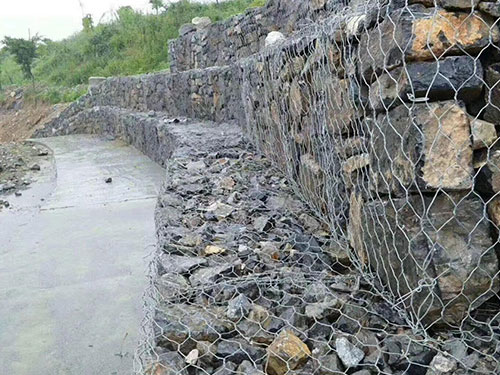
Engineers classify a gabion retaining wall as a *gravity* structure. Rather than resisting the lateral push of retained soil through bending strength in a thin concrete panel, it simply outweighs the problem. Rock-filled wire baskets, stacked in courses, form a heavy mass; as long as that mass is large and well-anchored enough, friction along its base and its sheer weight prevent it from sliding forward or tipping over, regardless of how hard the soil behind it pushes. This is the same basic principle behind an old-fashioned stone dam or a rubble breakwater — mass over cleverness.
Two further properties set gravity gabion walls apart from an equivalent poured concrete gravity wall, and both trace back to what the structure is made of. The first is permeability. A concrete wall is essentially solid, so groundwater trapped behind it builds up hydrostatic pressure — an additional, often underestimated load that engineers must design against, typically with drainage pipes threaded through the concrete. A gabion wall needs none of that: with roughly a third of its volume made up of voids between stones, water simply drains through the structure itself, continuously relieving pressure that would otherwise accumulate. The second property is flexibility. Soft or uneven foundation soil beneath a rigid concrete wall tends to produce cracking as the structure settles unevenly. A gabion wall, built from many individually flexible units, can accommodate that same differential settlement by shifting slightly at the joints between baskets, without opening structural cracks.
These advantages come with a trade-off in bulk. Because a gravity structure relies on mass rather than reinforced strength, a gabion wall generally needs a considerably larger cross-section — engineering studies of comparable structures cite figures on the order of three to five times more material by volume — than a reinforced concrete retaining wall built to hold back the same height of soil. Site constraints sometimes rule gabions out for this reason alone; there simply may not be room for a wide-footed gravity wall.
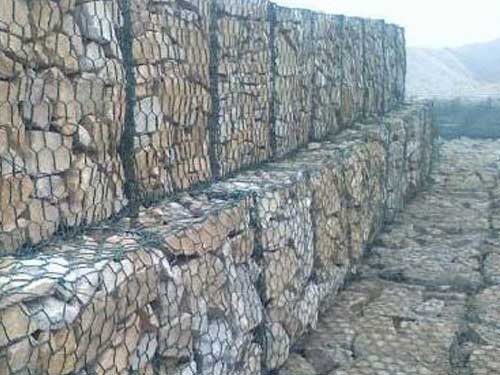
Where space does allow it, though, designers typically improve stability further by stepping each course back slightly from the one below — a modest batter of roughly one unit horizontal to six vertical is common — shifting the wall's overall center of gravity toward the retained slope and measurably improving its resistance to both sliding and overturning.

Check more information about gabions?
Tell us your request and get a free quote