
Anatomy of 'Breathing Stones': The Physical Working Principles of Gabions
An in-depth analysis of gravity stabilization, structural flexibility, and hydraulic permeability governing gabion performance.
1. Introduction
The engineering designation of gabions as 'breathing structures' captures their fundamental divergence from traditional rigid retaining walls and impermeable concrete revetments. While rigid structures rely entirely on mass and unyielding bending resistance to withstand lateral earth and water pressures, gabions operate through an integrated system of granular friction, mechanical flexibility, and hydraulic transparency. Understanding these physical principles is essential for predicting structural behavior under complex geotechnical and hydrological boundary conditions.
2. Gravity Stabilization and Internal Friction
At the macroscopic level, a gabion gravity retaining wall or revetment functions primarily through self-weight. Individual stone aggregates contained within the wire mesh are consolidated into a monolithic composite block possessing a high bulk density (typically ranging from 1,500 to 1,800 kg/m³ depending on stone specific gravity and packing porosity). According to fundamental principles of geotechnical engineering, when lateral earth pressure exerted by retained backfill acts against the wall, the gabion structure resists overturning and sliding through its dead weight and the development of basal shear resistance. However, unlike monolithic concrete blocks, internal stability in a gabion structure is maintained through inter-particle locking. The crushed rock infill relies on high internal angle of friction between individual angular stones. Under external loads, minor internal shifting occurs, allowing the stones to rearrange and re-establish static equilibrium without generating high localized bending moments that would cause brittle fracturing in rigid materials.
3. Structural Flexibility and Differential Settlement Adaptation
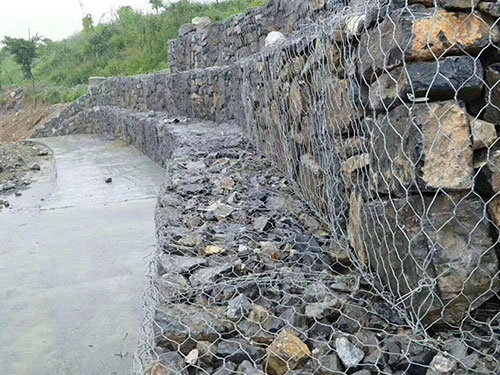
Geotechnical foundations in riverbanks, coastal zones, and mountainous terrain are notoriously heterogeneous, frequently subject to differential settlement, frost heave, and seismic tremors. Rigid structures constructed from reinforced concrete or masonry possess high elastic moduli and low tensile ductility, rendering them highly susceptible to cracking, shear failure, and catastrophic collapse when subjected to underlying soil movement. In stark contrast, gabions exhibit exceptional structural flexibility. The double-twisted hexagonal wire mesh and the hinged, modular nature of individual baskets allow the entire structure to act as an articulated, flexible membrane. When differential settlement occurs beneath a gabion wall, the wire mesh undergoes elastic and plastic elongation while the internal stone matrix deforms internally to accommodate the ground profile. This continuous deformation occurs without loss of structural integrity or substantial reduction in load-bearing capacity, rendering gabions uniquely resilient in unstable geologic environments.
4. High Permeability and Hydrostatic Pressure Neutralization
One of the most critical failure modes in conventional retaining walls is the accumulation of hydrostatic pressure behind the structure. In impermeable concrete walls, inadequate or clogged weep holes often lead to high pore water pressures during heavy precipitation or rapid drawdown events, dramatically increasing overturning moments. Gabions eliminate this vulnerability through their inherent high permeability. The interstitial voids between stone infill (typically maintaining a porosity of 30% to 40%) provide an unobstructed internal drainage pathway. Groundwater, seepage, and surface runoff flow freely through the gabion body, instantly dissipating hydrostatic head and preventing the development of destructive pore water pressures. This hydraulic transparency ensures superior slope stability under severe hydrological loading.

Check more information about gabions?
Tell us your request and get a free quote