
Wire, Zinc, and Stone: The Materials Science Inside a Gabion
A gabion looks simple from a distance, but its performance depends on a surprisingly specific set of material choices, most of which are unglamorous but essential.
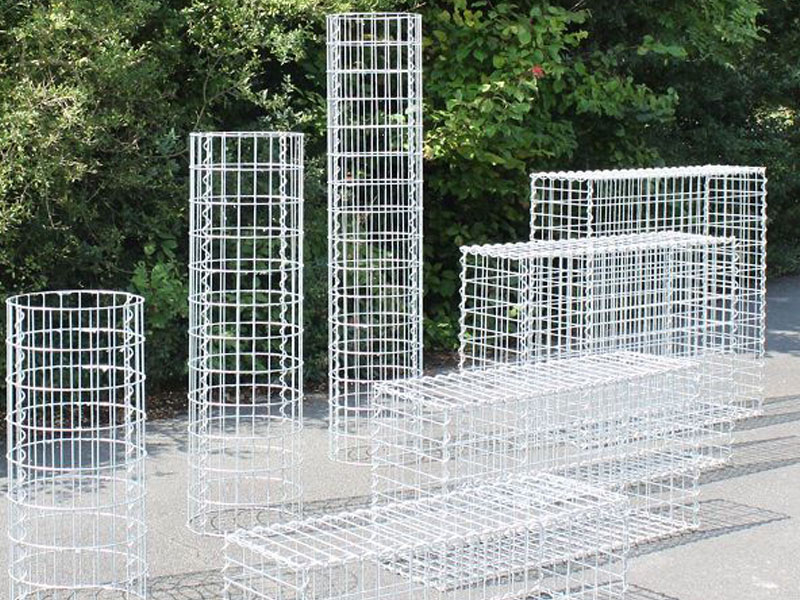
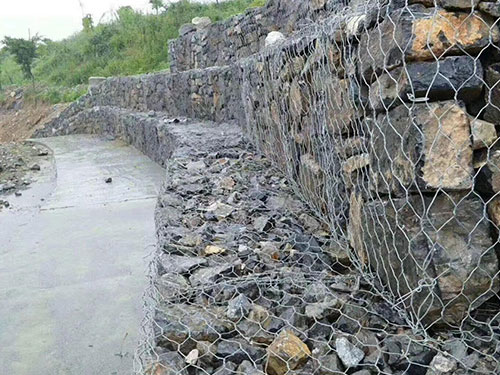
Start with the mesh. Two basic constructions dominate the industry. Double-twisted hexagonal woven mesh — pairs of wires twisted around each other several times at each junction — is the traditional form, prized because a break at any one point does not readily unravel the surrounding fabric, and because the whole panel flexes somewhat under uneven loading rather than snapping. Welded mesh, by contrast, forms a rigid grid with wires fused at every intersection; it holds its shape more precisely during filling but is less forgiving of ground movement. International standards govern both: EN 10223-3 in Europe and ASTM A975 (woven) or A974 (welded) in the United States describe acceptable wire diameters, mesh openings, and strength.
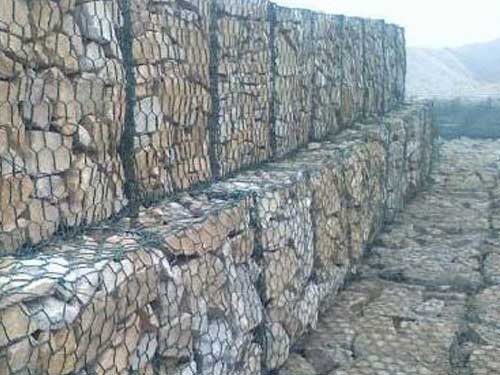
Wire diameter and mesh opening are chosen together. A typical woven gabion uses body wire around 2.7 millimeters thick, with heavier "selvedge" wire — often 3.4 to 4 millimeters — reinforcing the panel edges, since edges bear disproportionate stress during handling and filling. The mesh opening itself, commonly around 80 by 100 millimeters, must be smaller than the smallest stones going inside; specifications generally call for rock in the 100- to 250-millimeter range, hard and weather-resistant, so that individual stones cannot work their way out through the gaps.
Corrosion protection is where gabion technology has advanced the most since the 1890s. Plain steel wire rusts quickly, so nearly all commercial gabion wire is hot-dip galvanized — coated in a layer of zinc that corrodes preferentially, sacrificing itself to protect the steel beneath. In more demanding settings, manufacturers add a second line of defense: a polyvinyl chloride or polymer coating roughly half a millimeter thick over the galvanized wire, or a zinc-aluminum alloy coating known as Galfan, which generally outperforms plain zinc in corrosion-resistance testing. None of these coatings is permanent. Independent field studies of decades-old installations, discussed later in this series, show that scratches from sharp stone edges, abrasion from moving river sediment, and simple time can eventually compromise even a well-specified coating — which is why manufacturers still publish design-life estimates as a range rather than a guarantee, typically citing a few decades in mild conditions and rather less in aggressive marine or industrial environments.
None of these details are visible to a passerby glancing at a gabion wall. But the difference between a structure that lasts twenty years and one that lasts eighty often comes down to exactly this kind of unglamorous specification: wire gauge, coating chemistry, and stone selection, chosen correctly before a single basket is ever filled.
_副本.png)
Check more information about gabions?
Tell us your request and get a free quote