
From Military Fortresses to Eco-Slopes: The Centennial Evolution of Gabions
Exploring the transformation of woven wicker battlefield barriers into high-performance ecological civil engineering structures.
1. Introduction and Etymological Origins
In contemporary civil engineering, river training, and geotechnical stabilization, gabions are recognized as robust, flexible, and permeable gravity structures composed of metallic mesh containers filled with stone aggregates. However, the etymological and historical roots of the term 'gabion' diverge sharply from modern engineering applications. Derived from the Italian word 'gabbione,' meaning 'big cage,' the earliest iterations of gabions bore no relation to soil mechanics, hydraulic engineering, or ecological restoration. Instead, they were conceived in antiquity as tactical military engineering assets designed to protect combatants from enemy projectiles, artillery fire, and cavalry charges.
2. Antiquity and Medieval Military Engineering
The historical lineage of gabion-like structures dates back to classical antiquity, including engineering practices utilized by the Roman Empire. Roman legionaries frequently employed woven plant material cylinders filled with compacted earth and stones to rapidly construct temporary fortifications, entrenchments, and artillery emplacements. During the medieval and Renaissance periods, as siege warfare evolved with the introduction of gunpowder and heavy artillery, the demand for rapid, field-deployable defensive barriers intensified. Military engineers utilized flexible wickerwork—fabricated from pliable branches of willow, hazel, or similar brushwood—to weave cylindrical, bottomless baskets on-site. Once erected in defensive positions, these baskets were filled rapidly with earth, sand, and rubble. This composite matrix of organic mesh and dense granular infill exhibited exceptional energy-absorption characteristics. Kinetic impact energy from early cannonballs and musket fire was dissipated efficiently through localized deformation of the fibrous wicker cage and internal frictional rearrangement of the soil particles, preventing catastrophic structural collapse. Throughout the 18th and 19th centuries, gabions became standard equipment in European military engineering manuals, extensively documented in conflicts such as the American Civil War (e.g., at Fort Stedman in 1865), where engineers utilized hundreds of wicker gabions to construct resilient parapets, battery revetments, and sheltered communication trenches.
3. The Industrial Turning Point of 1894
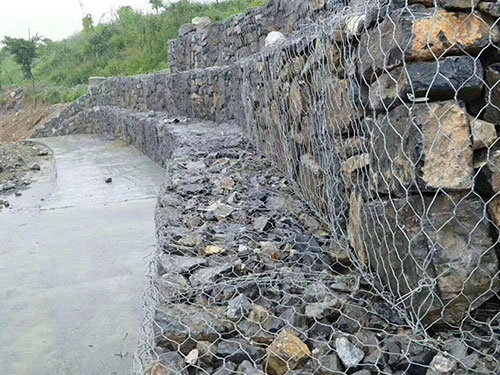
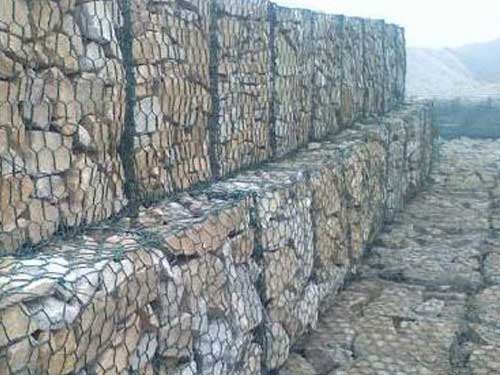
The transition of gabions from temporary, biodegradable military improvisations to permanent civil infrastructure occurred at the close of the 19th century. The critical inflection point transpired in 1894, when a prominent European engineering enterprise revolutionized the concept by replacing perishable plant fibers with industrial low-carbon steel wire and introducing the double-twisted hexagonal mesh configuration. During this period, northern Italy's Reno River basin suffered from chronic, catastrophic embankment failures and seasonal flooding. Traditional rigid masonry and mass concrete structures repeatedly failed along the river's unstable alluvial foundations due to severe differential settlement and immense hydraulic shear stresses. To address this geotechnical challenge, engineers fabricated mechanical wire mesh containers filled with hard local stone. The introduction of industrial wire drawing and mechanical twisting techniques ensured that the metallic mesh could sustain immense tensile loads while adapting seamlessly to foundation movements without structural failure. This pivotal innovation marked the birth of modern commercial gabions, shifting their functional paradigm from military defense to permanent river training and slope stabilization.
4. Evolution into Modern Ecological Engineering
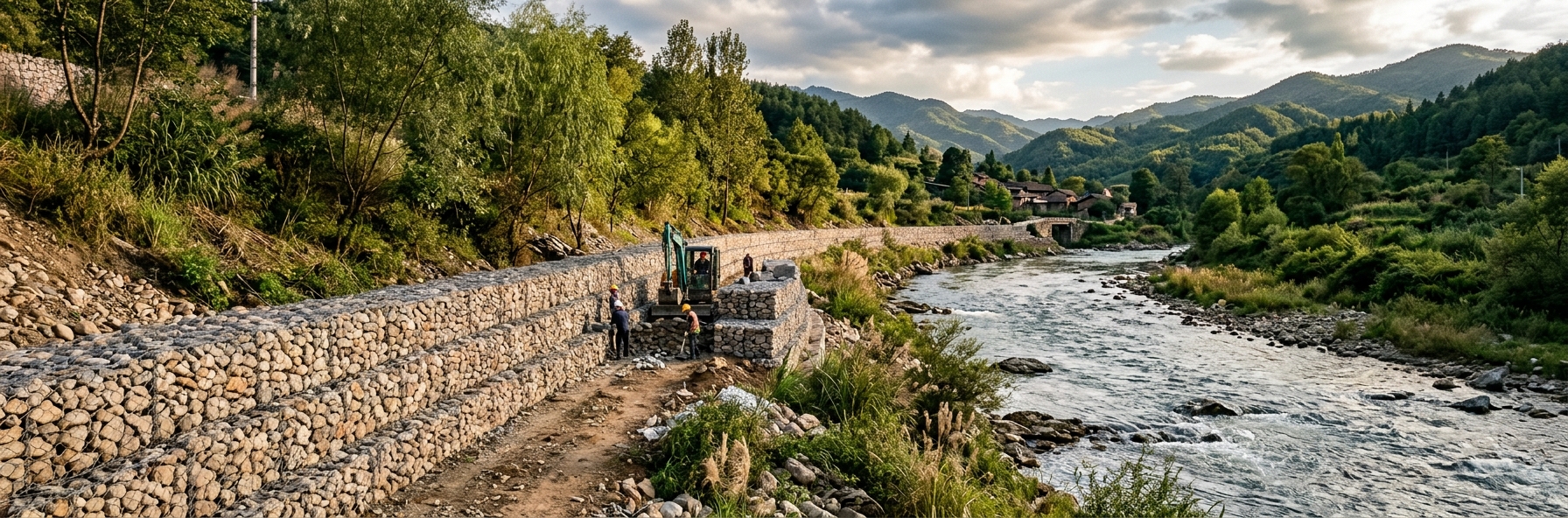
Throughout the mid-to-late 20th century, civil engineering philosophy underwent a profound paradigm shift. Traditional approaches characterized by rigid, impermeable concrete channelization and hard armor frequently disrupted local hydrological cycles, accelerated downstream erosion, and destroyed aquatic and riparian ecosystems. In response, modern geotechnical and hydraulic engineers recognized gabions as an ideal bridge between structural stability and ecological integration. By virtue of their high porosity and interconnected stone matrix, gabions permit natural subsurface drainage, eliminate hydrostatic pressure build-up behind retaining walls, and create interstitial voids that readily accumulate fine sediments and organic matter. This natural accumulation facilitates spontaneous vegetative colonization, allowing native flora to root within the structure. Consequently, over time, sterile metallic-and-stone assemblies transition into living, self-healing biological green walls and vegetated revetments. Furthermore, metallurgical advancements—such as the development of heavy hot-dip galvanizing and advanced zinc-aluminum-mischmetal alloy coatings, alongside high-performance polyvinyl chloride and polyolefin polymer extrusions—substantially enhanced the long-term corrosion resistance and service lifespan of gabions in aggressive aquatic and soil environments, codifying their status as a cornerstone of sustainable ecological engineering.
Check more information about gabions?
Tell us your request and get a free quote