
Taming Rivers: Gabions in Erosion Control and Flood Defense
Rivers rarely stay where engineers would like them to. Moving water carries enormous energy, and during floods that energy is more than capable of tearing away riverbanks, undercutting bridge foundations, and shifting a channel's entire course within a single storm season. Gabions have become one of the standard tools for managing that energy without simply paving the riverbed in concrete.
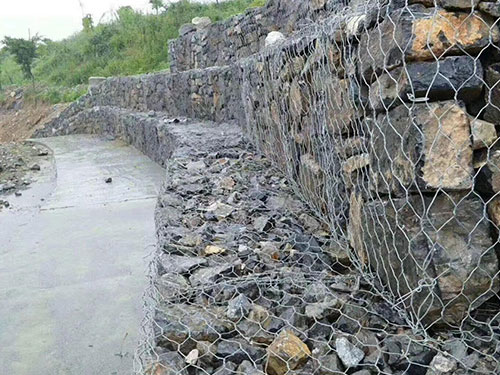
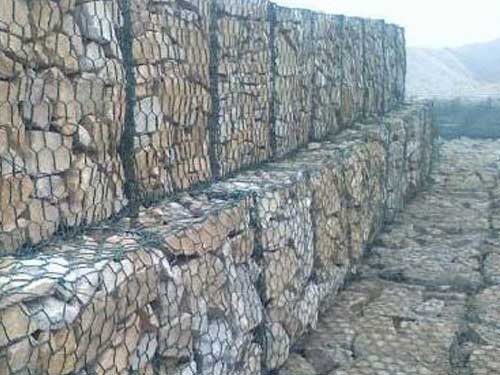
The basic strategy is to line a vulnerable bank or channel with rock-filled wire structures — often a combination of taller gabion baskets forming a low revetment wall and flatter Reno mattresses protecting the toe and bed nearby — so that the river dissipates its energy against durable, interlocking stone rather than eroding soil directly. Because the structure is permeable rather than solid, water moving through and around it loses momentum gradually, through friction among the individual rocks, instead of being deflected sharply the way it would be by a smooth concrete wall, which can actually accelerate scour at its base.
This approach has proven especially practical in regions where importing large volumes of concrete, or the heavy equipment to place it, is expensive or logistically difficult. A widely cited study of riverbank protection along the Aakhukhola river in Dhading, Nepal, for instance, examined several modified gabion revetment designs specifically as a cost-effective option for flood mitigation in a developing-country context, where existing structures had often suffered from poor construction quality and inadequate planning. Gabions suit that setting well: they can be built largely by hand, using stone gathered near the site, without specialized machinery or imported materials.
Over time, a well-built gabion revetment tends to become more effective rather than less. Fine sediment carried by the river settles into the gaps between the larger stones, gradually filling voids near the surface; seeds arriving on the wind or in the water then find enough of a foothold to establish vegetation, whose roots add another layer of reinforcement the original design never explicitly accounted for. In the best cases, a gabion structure installed as bare wire and stone slowly blends into something closer to a naturally vegetated bank.
None of this happens automatically, however. Riverbank gabion works still fail when basic design details are skipped — inadequate embedment below the depth a flood is likely to scour, stone too small or too soft for the flow conditions, or insufficient tying between adjacent units. Those failure modes, and what field studies of collapsed installations have taught engineers about avoiding them, are the subject of a later article in this series.

Check more information about gabions?


Tell us your request and get a free quote